32 tasks
MedTool
Medical tool use
Read patient data, choose clinical calculators, and return the correct numeric results.
Patient recordsCalculations
NORTHWESTERN UNIVERSITY
A Controlled Evaluation of LLMs and
Agent Harnesses on Medical Tasks
Northwestern University
The model is one part of an agent. We study how the harness changes its performance across four kinds of medical work—and which mechanisms make a difference.
THE BENCHMARK
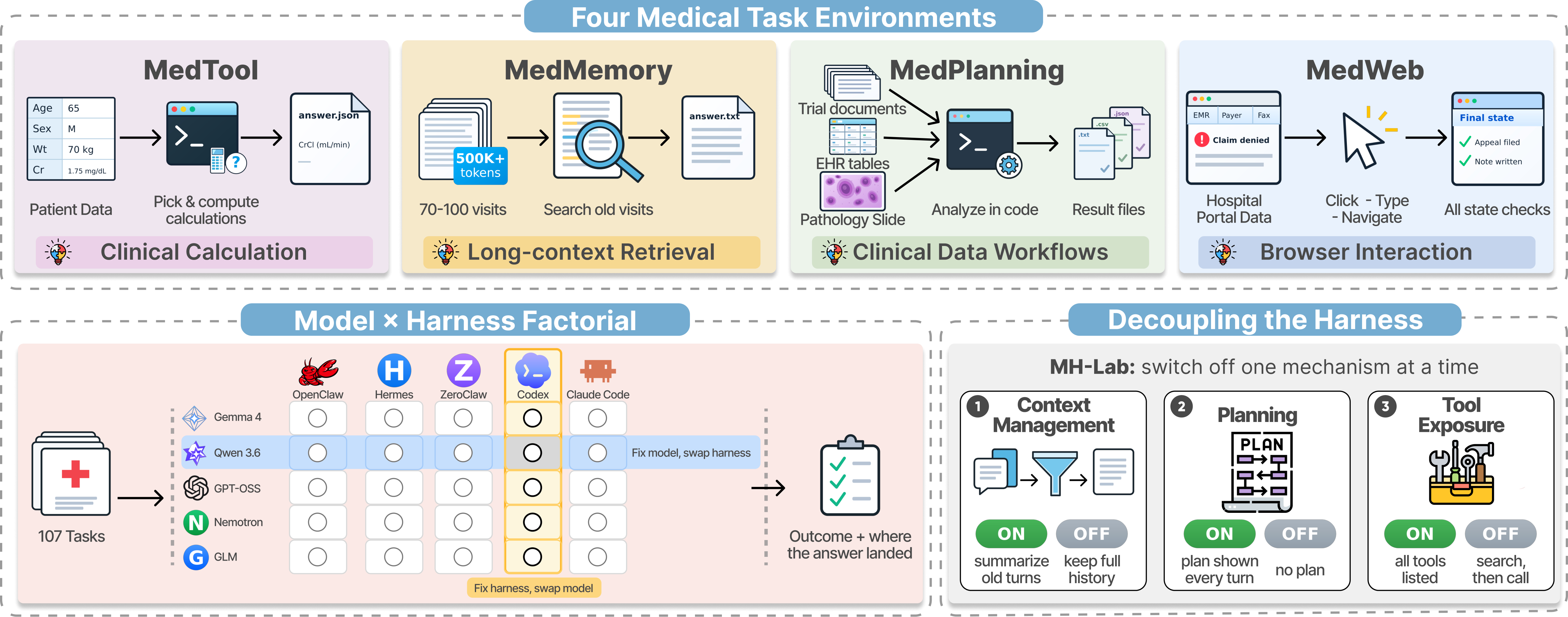
MedicalHarnessBench brings together 107 tasks adapted from four public benchmarks. Each environment tests a different capability needed to turn a medical request into a completed task.
Medical tool use
Read patient data, choose clinical calculators, and return the correct numeric results.
Long-context retrieval
Find the evidence needed to answer a question within a long history of patient consultations.
Medical data workflows
Work through clinical records, trial eligibility, and pathology tasks to produce structured outputs.
Browser interaction
Complete administrative workflows across an EMR, a payer portal, and a fax portal.
THE STUDY DESIGN
We ask how much outcomes change with the harness, where those differences arise, and when an individual mechanism helps.
Five open-weight models run under five product harnesses on the same tasks. Within each model, comparisons share the model checkpoint, serving stack, context window, and episode budget, with three seeds.
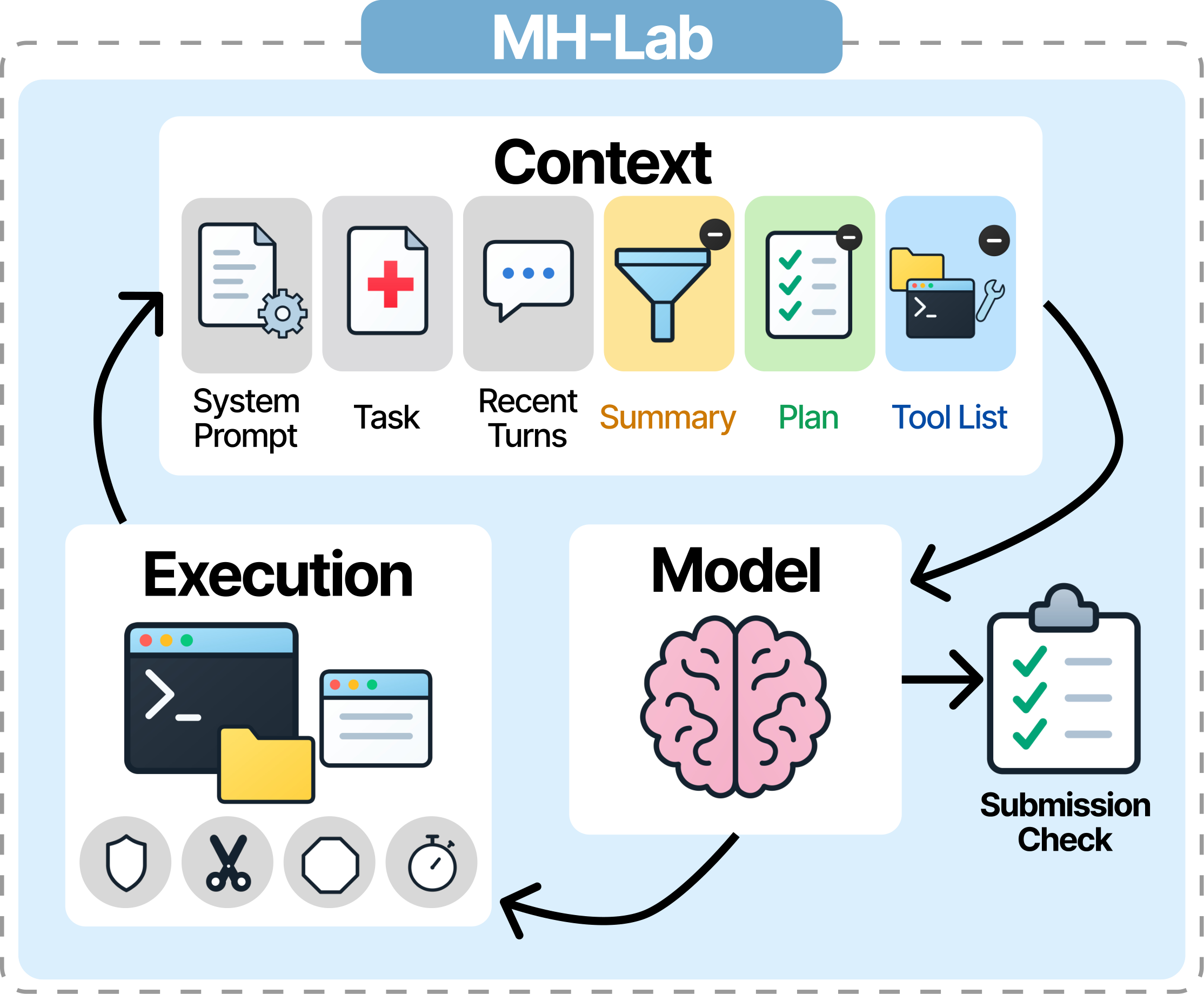
MH-Lab keeps the model and execution loop fixed while changing context management, planning, or tool exposure. Traces show whether a mechanism was used and how behavior changed.
EXPLORE THE RESULTS
Browse all 25 model–harness pairs in each environment. Each value summarizes three seeds on the same task set.
Loading the released study results…
| Model | OpenClaw | Hermes | ZeroClaw | Codex | Claude Code |
|---|---|---|---|---|---|
| Loading results… | |||||
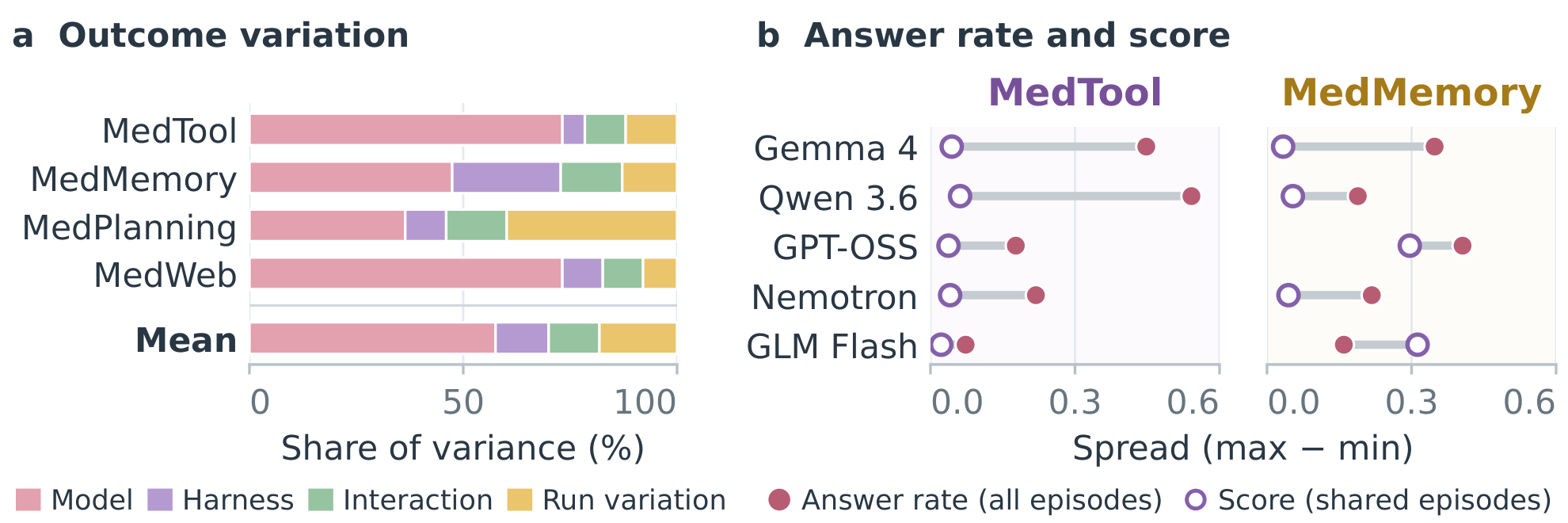
≈24%
Equal-weight average across the four environments. No single harness is best across models and tasks.
Execution traces separate answer availability from answer quality, then locate the different failure modes in each environment.
Controlled switches test context management, planning, and tool exposure within the same agent loop.
CONTROLLED MECHANISM STUDY
A shared agent loop with explicit switches.
To examine one mechanism at a time, MH-Lab keeps task tools, model, and execution conditions fixed within each comparison.
BUILD ON THIS WORK
Install the code, check the execution loop locally, then connect your own model endpoint. The repository documents the task data and harness configuration.
The smoke test uses a local test endpoint and runs without a GPU. Bootstrap first installs the pinned runner and project patches.
Full setup instructionsgit clone https://github.com/REAL-Lab-NU/MedicalHarness.git
cd MedicalHarness
python -m pip install -e '.[dev]'
medicalharness bootstrap
medicalharness smokeReal episodes run on Linux with bubblewrap. After installation and bootstrap, start an OpenAI-compatible model server and replace MODEL and the endpoint below with your deployment. The MedTool export uses data included in the repository.
python scripts/export_calc_to_harnessbench.py --output tasks
medicalharness run-one \
  --tasks tasks --task medcalc-001 --harness mhlab \
  --model MODEL --upstream http://127.0.0.1:8000/v1 \
  --output runs/example
CITATION
If you use MedicalHarnessBench, MH-Lab, or these evaluation results, please cite MedicalHarness.
@misc{wang2026medicalharness,
  title  = {MedicalHarness: A Controlled Evaluation of LLMs and
            Agent Harnesses on Medical Tasks},
  author = {Wang, Ziqing and Zhao, Lili and Ding, Kaize},
  year   = {2026},
  url    = {https://github.com/REAL-Lab-NU/MedicalHarness}
}